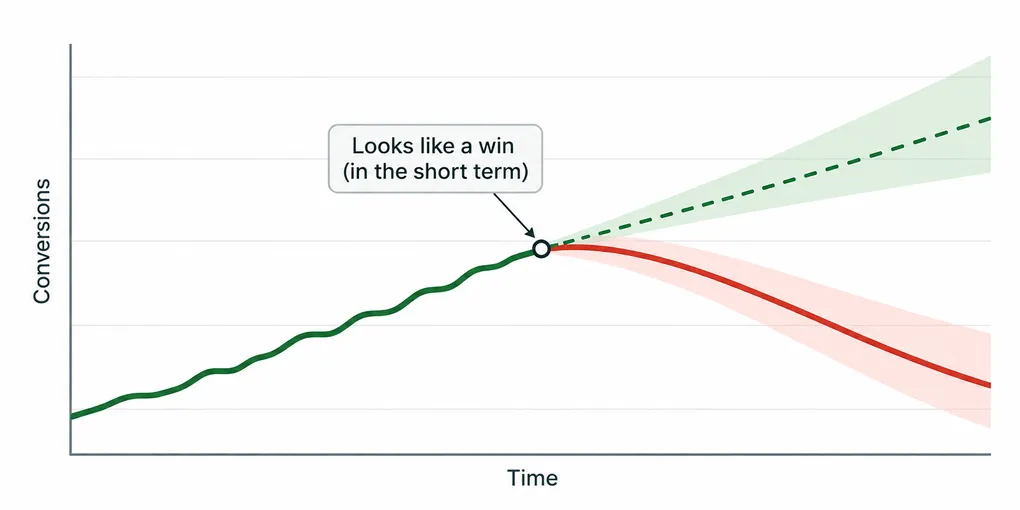
How your best prospects could be killing your business
We did it. We ran an experiment and we found a lift!
This is why we do it. This is why we run experiments. We’re a Data Driven Organization that runs experiments just like the FAANGs do.
What could go wrong?
Experiments can steer us wrong if we’re not careful.
One example we’ve seen over and over again is when a change plays out drastically differently for one group than for another.
Imagine an experience that the top 10% of prospects respond to favorably, but everyone else hates. Maybe they already know you and the message hits hard, but for everyone else it goes right over their heads.
To illustrate this, let’s walk through an example.
Heterogeneous effects
We’re a meal plan delivery subscription service trying to optimize our emails for conversion. Money is tight this quarter, and the CFO says we need to squeeze every sale we can from every lead.
We decide to test a heavy, urgent message with a nice discount on top, sent to all leads after they fill out one of our many lead forms.
Leads are split nice and randomly between test and control: 50% get our regular old email experience and 50% get our new test message.
Time to experiment.
The test runs for 8 weeks, and our marketers report a +0.23pp lift with a better than 99.9% probability that the lift is greater than 0!
Great, so what’s the problem, right?
Who the lift comes from
The problem lies in who that lift is coming from…
Not all leads are created equal. To be specific, hiding in those leads are former paying members of our service. They’re a small but mighty group.
Let’s call them formers, and everyone else non-formers. Before the experiment, we knew who was who, but we figured our randomized controlled test would handle that for us.
And for the headline, it did. With high confidence, it answered the question:
What lift in conversions would we see from this population if the treatment experience were offered to every qualifying lead?
Here’s what things look like if we split the test by formers and non-formers:
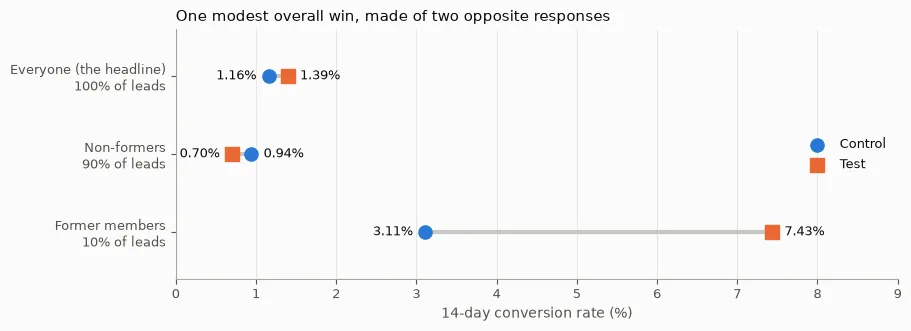
Formers bought from our discount email at a whopping 7%, more than 2x the rate of formers in the control (3%).
But everyone else, 90% of our leads, responded negatively. We see a drop from about 1% to 0.7%. It’s a small drop, but compounded over a large audience, it’s a big problem.
How did we miss this?
How a win turns into a slow decline
So how does this explain the scary headline of this article?
Let’s take this to an extreme and start to spiral with some assumptions:
- We’ve optimized a conversion experience for a small group of prospects.
- Discount buyers tend to churn at a faster rate.
- We acquire fewer and fewer new members, so the pool of formers starts to dwindle.
- Fewer new members flowing in means fewer referrals, since new members tend to refer their friends most often when they first start.
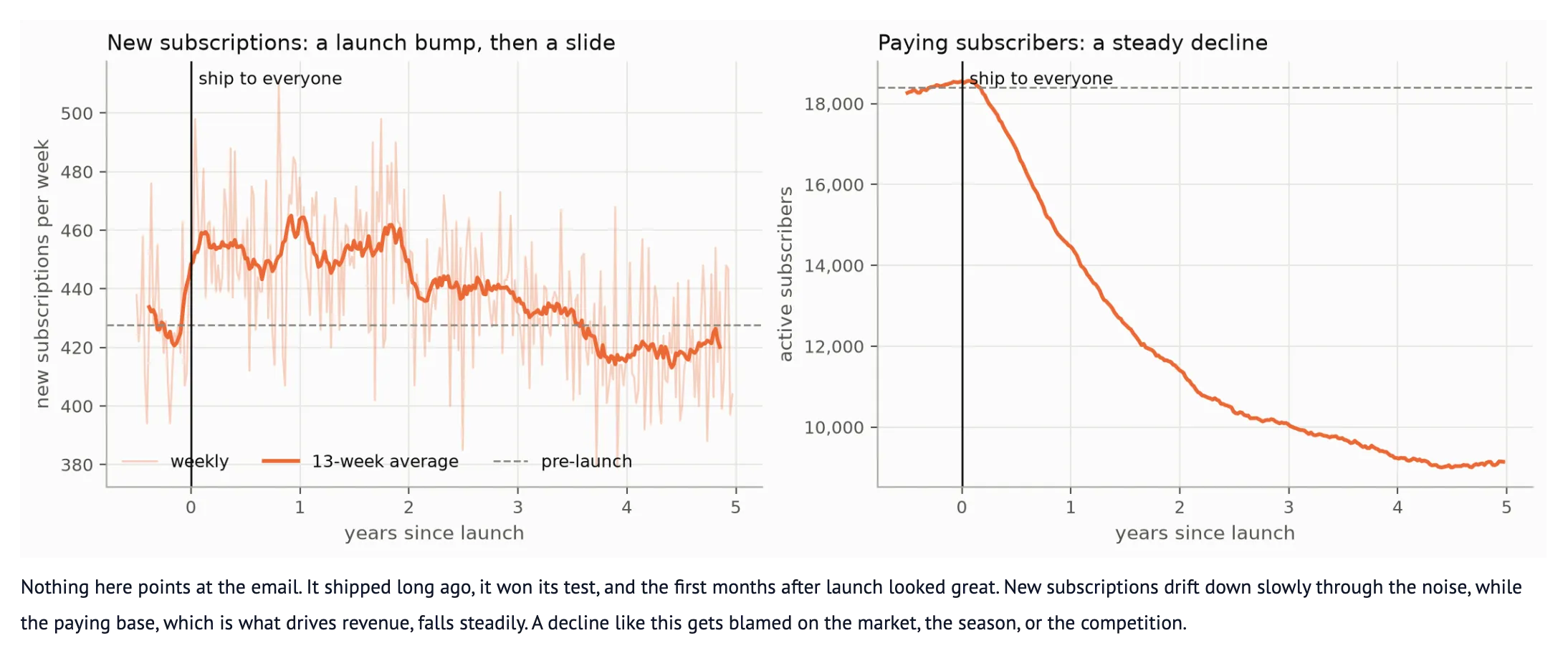
Five years later, we’re seeing a visible downtrend and probably blaming it on the brand or the marketing team.
What to do about it
So what can we do about it? We don’t want to optimize for every subgroup.
But there are likely discernible groups we might want to split by when we’re trying to micro-optimize our funnels.
Look at what the same simulated story might look like if we prescribed a different treatment to each group.
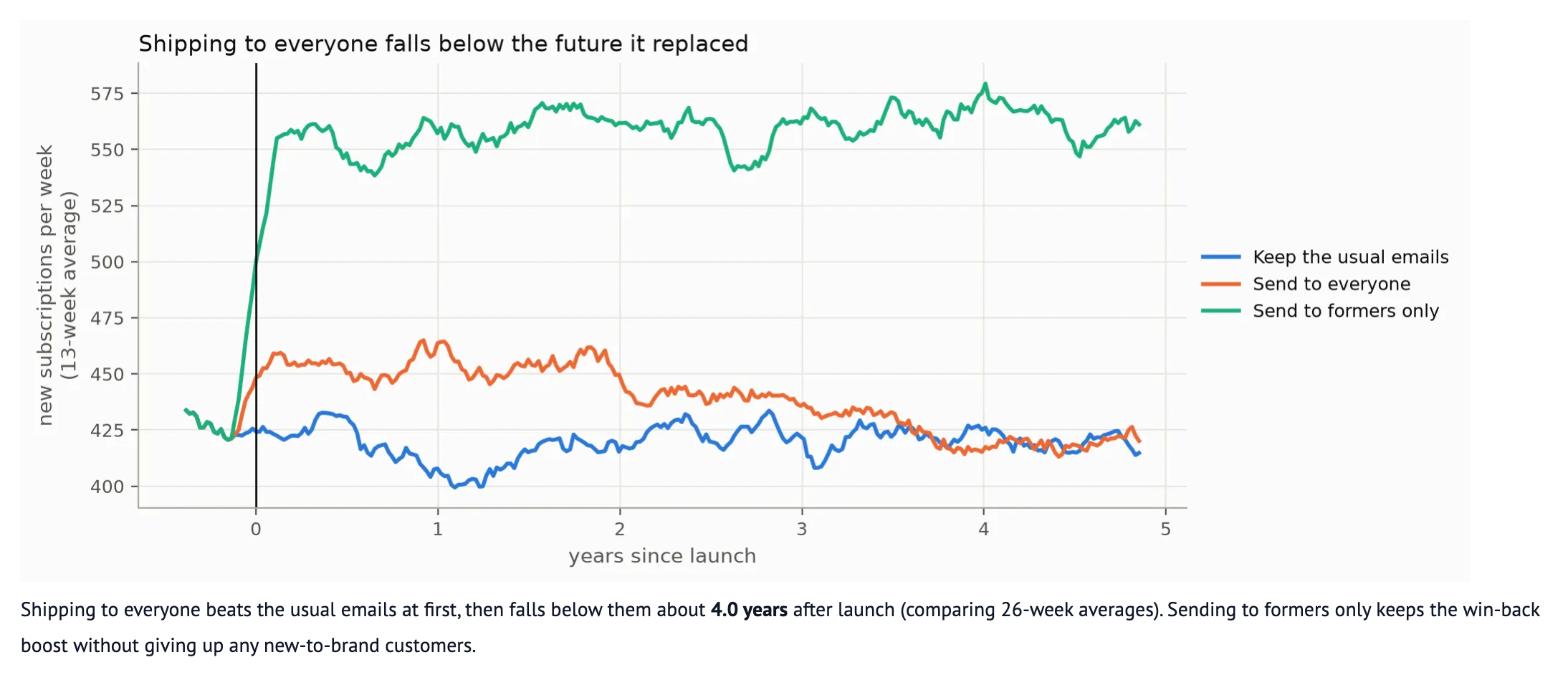
Now we can really celebrate a win?
A thoughtful analyst can handle this:
- Roll out the test version to formers.
- Keep the control for everyone else.
A win-win.
But what about cash? That’s what we really care about.
[part 2 coming soon]